Hans Hubermann’s repainting of Kleinmann’s shop
The Book ThiefHans Hubermann’s repainting of Kleinmann’s shop is significant because it turns private conscience into visible public disobedience. In a town where Nazi persecution is written directly onto Jewish property, Hans answers an act of destruction with the practical labor he knows best: he returns to repair the damaged door. The work is compassionate, but it is also dangerous, and the narrative identifies it as the second of two mistakes that shape his precarious position in Nazi Germany.
Background and Political Pressure
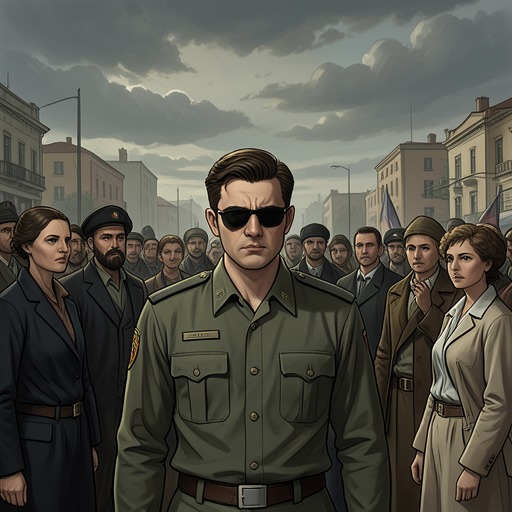
As Jews were increasingly terrorized throughout Germany, Hans finally submitted an application to join the Nazi Party in the spring of 1937, almost to his shame. His application was a form of protection in a society where political belonging could determine whether a person was trusted, tolerated, or endangered. The decision placed him inside the machinery of the state without making him inwardly loyal to it.
Immediately after lodging the form at the Nazi headquarters on Munich Street, Hans encountered the limits of that compromise. Four men had thrown bricks into Kleinmann’s, one of the few Jewish shops still operating in Molching. A mustard-colored star had been smeared across the door, while the words “JEWISH FILTH” spilled across it in sloppy lettering. The violence was not hidden or accidental: the shop’s identity had been publicly marked, and the broken glass made persecution part of the street itself.
The Repainting
Hans moved closer and looked inside. Joel Kleinmann was cleaning the shop, holding a dust broom almost powerlessly as he crushed the glass beneath his feet. Hans had painted Kleinmann’s house the previous year and remembered the faces of his three children, even though he could no longer recall their names. That prior connection prevents the vandalized shop from remaining an abstract political target; for Hans, it belongs to a family he has encountered as neighbors and clients.
When Kleinmann told Hans to go away, Hans did not argue or perform a public defense. He offered a concrete promise: he would return the next day and repaint the door. He did exactly that. The action is modest in material terms, but its meaning is difficult to conceal. Repainting removes, or at least covers, a visible insult imposed by the Nazi campaign. Hans uses his trade to restore the surface that the persecutors have deliberately transformed into a sign of exclusion.
Immediate Consequences
The repainting was called the second of Hans’s two mistakes. The first came immediately afterward, when he returned to the Nazi office and struck the door and window with his fist. The glass shuddered, but nobody answered; the officials had already gone home. Rolf Fischer, identified as one of Molching’s greatest Nazis, saw Hans as he walked away. Within sixteen hours, a new slur had been painted on the door.
Hans was not granted membership in the Nazi Party—not yet. His application remained active, however, and for the next year he was fortunate that he did not officially withdraw it. His refusal to leave the damaged shop untouched therefore produced a bureaucratic and social penalty rather than an immediate arrest. The state could delay his admission, mark him as suspicious, and tolerate him only conditionally.
Long-Term Effects on Hans and His Household
For roughly the next year Hans remained on a waiting list while many other applicants were approved instantly. He was regarded with suspicion, but his pending application also served as evidence that he was attempting to place himself within the accepted political order. When Kristallnacht led to the complete removal of Jews from Molching, the Gestapo searched the Hubermanns’ house. They found nothing suspicious, and Hans was allowed to stay. His apparent willingness to join the Party helped protect him, even though the incident at Kleinmann’s had shown that his conduct could not be reduced to official allegiance.
The consequences later became more complicated. Hans’s application was eventually approved, and the news arrived in the mailbox while his conscience over Max Vandenburg already weighed on him. The approval, which might ordinarily have appeared as good news, instead became another source of distress. The sequence links the repainting to a continuing pattern: Hans repeatedly seeks safety through outward compliance, yet his actions toward persecuted Jews make that compliance unstable and morally incomplete.
Historical and Narrative Significance
The action stands against the larger public rituals of Nazi Germany. Molching displays flags for Hitler’s birthday, gathers crowds beneath Nazi uniforms, and turns the town square into a place of cheering and burning. In that environment, political identity is performed through flags, salutes, songs, and obedience. Hans’s repainting is the opposite kind of gesture: private, manual, and directed toward repairing the property of someone the state has designated as an enemy.
Its power lies partly in its scale. Hans does not overturn the regime, rescue the entire town, or prevent the persecution of Jews. He paints one door after four men have smashed one shop. Yet that limited act reveals how ideology depends on ordinary surfaces and ordinary cooperation. A slur must be written; a star must be displayed; a window must be cleaned; a flag must be found and hung. Hans interrupts that process with a brush and a promise, and the interruption is enough to make him suspicious.
The episode also anticipates the risks surrounding Hans’s later help for Max Vandenburg. When Max arrives at 33 Himmel Street in November 1940, the Hubermanns experience fear, anxiety, disbelief, and paranoia, but they resist hysteria. The earlier repainting has already established the principle that governs Hans’s conduct: compassion may be dangerous, yet refusing to act can be morally intolerable. Kleinmann’s door is therefore not merely repaired; it becomes an early record of the choice that will place Hans and his family in continuing danger.